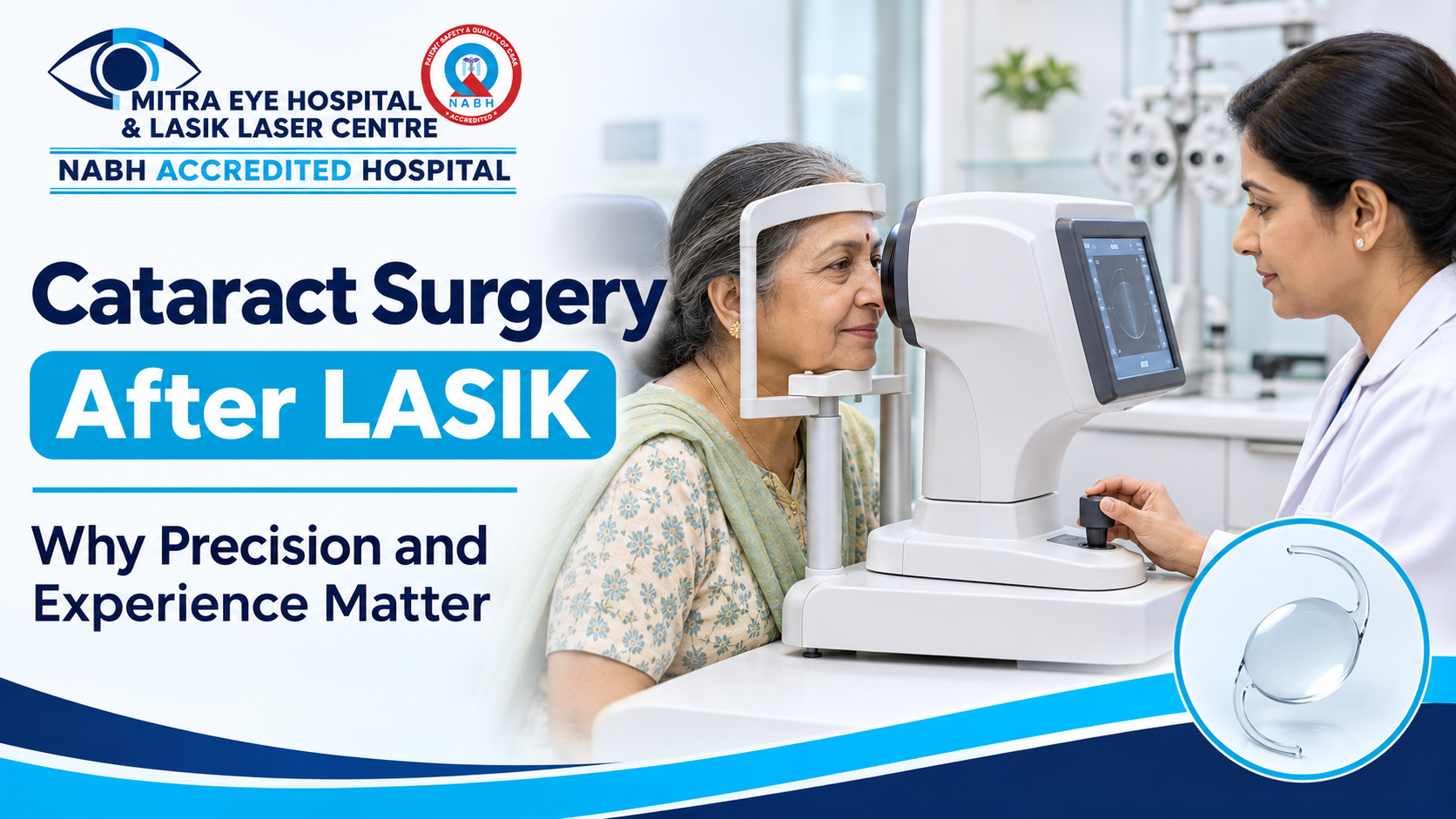
Patients who underwent LASIK surgery years ago are now reaching the age when cataracts begin to develop naturally. The common question asked most of the time is whether previous LASIK affects the outcome of cataract surgery, and the answer is yes, you can definitely have cataract surgery after LASIK. In fact, it's done successfully every day. However, cataract surgery after refractive surgery needs a more advanced and customised approach than the standard cataract procedures.
LASIK surgery permanently changes the shape of the cornea, which may make the lens calculation easier during cataract surgery. That does not mean that outcomes are certain. It means technology, accuracy and experience of surgeons are more important.
With modern lens technology, the right diagnostic tools and experienced surgeons in both refractive and corneal surgery, patients can achieve successful outcomes.
Cataract surgery and LASIK surgery difference
To understand why cataract surgery becomes complex after LASIK, it helps to understand what actually changed with LASIK.
During LASIK surgery, the cornea is reshaped to correct farsightedness, nearsightedness and astigmatism. For the long term, the reshaping of the cornea in cataract surgery changes the front surface of the eye. Years later, when cataract surgery is required, those changes can interfere with standard measurements surgeons depend on to calculate the power of the replacement lens.
Corneal measurement is used in traditional cataract surgery to determine intraocular lens power. In eyes with post-LASIK, those measurements may become less predictable because the cornea will not behave like a naturally shaped cornea.
This may involve the risk of :
Over correction
Under correction
Residual farsightedness and nearsightedness
More dependence on glasses than expected
This is not a complication of LASIK. It's simply not considered a complication of LASIK. It is a challenge that requires more advanced planning and experienced surgeons.
Importance of precise measurement
Advanced cataract surgery is highly dependent on accurate measurement.
Post-LASIK cataract evaluations include:
Detailed corneal mapping
Advanced formula for lens calculation
Comparing various measurement methods
Carefully reviewing the past refractive history
The main goal is to create accurate estimates for lens selection.
As post-LASIK eyes are more complex, surgeons can manage these cases using various calculation formulas instead of depending on a single formula. Accuracy at this stage plays a major role in how satisfied patients are with their vision after surgery.
Why choose refractive and cornea specialists
Not every cataract surgeon treats patients who previously underwent LASIK. Standard cataract surgery is common; post-refractive cataract surgery needs a deep understanding of how corneal surgery changes the eye over time.
This is where choosing refractive and cornea specialists makes the difference. An experienced specialist understands:
How LASIK change the corneal measurement
Which formula is reliable in complex eyes
How to understand advanced imaging data
How visual expectations can be managed
Which lens technology provides the best outcome
Patients also benefit from access to advanced diagnostics, which are designed for difficult lens calculations.
At Mitra Eye Hospital & LASIK Laser Centre, surgeons are specialised in both cataract and refractive surgery. That combined expertise is valuable for patients who had LASIK years ago and now want the best results from cataract surgery.
What results can be expected?
The majority of patients who undergo cataract surgery after LASIK experience improvement in vision.
It's important to understand that outcomes can be less predictable compared to eyes that never had LASIK.
Even with the proper planning, LASIK eyes may have the chance of needing:
Glasses for some activities
Minor adjustment in prescription
Procedure for enhancement in some cases
Setting realistic expectations is an important part of the entire procedure. The goal is achieving the best vision for the lifestyle and needs.
How can a light-adjustable lens change the outcome?
The major advancement in cataract surgery is the light-adjustable lens. Traditional cataract surgery is selected before surgery, which means surgeons depend on pre-operative measurements to predict the final outcome. In post lasik eyes, sometimes that prediction can be difficult. The light adjustable lens changes the entire process.
Rather than locking in the prescription before surgery, the light adjustable lens allows the doctor to adjust the power of the lens after surgery, once the eye heals and real vision can be evaluated.
Get a customised plan for your eye
If you previously had LASIK and are now developing cataracts, then in this situation, a personalised evaluation is the best way to understand the best option. At Mitra Eye Hospital & LASIK Laser Centre, the team of experienced eye surgeons is able to handle complex cases, including patients who want cataract surgery after LASIK. With the personalised diagnosis and treatment from Dr. H. Mitra, patients can achieve the clearest vision possible based on their vision and goals.